The Real Reasons Student Visas Get Rejected
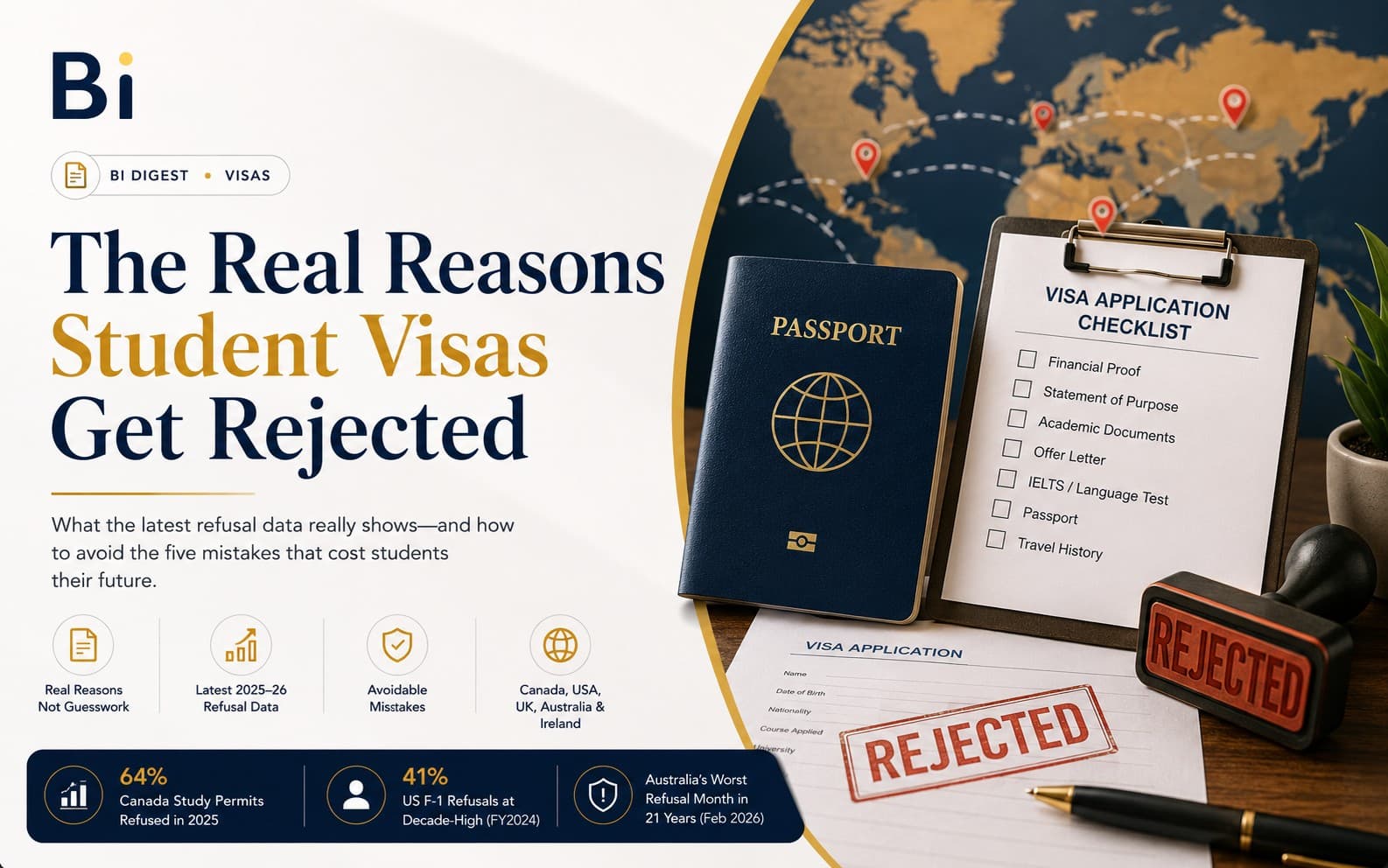
Student visas are refused for documented, specific reasons, and refusals are at record highs across every major destination. The reasons cluster into five categories, and almost every one is visible in the file before it's submitted.
By Mandeep Singh · Published 4 August 2026
The scale of it, first
Every week, students walk into our offices holding refusal letters they don't understand. The letter cites a paragraph of immigration law. The student reads it as "they didn't believe me." Both are true, and neither explains what actually happened. So here is what actually happens, country by country, with this year's numbers rather than the recycled statistics most guides still quote.
The polite fiction that visa refusal is a rare accident befalling careless applicants died somewhere around 2024. The table below is the current picture.
| Destination | Refusal reality | The detail that matters |
|---|---|---|
| Canada | Refusals peaked ~65% in early 2025, the toughest in a decade | 74% of Indian applications refused in Aug 2025 per IRCC data; a separate IRCC Visa Integrity report put it at 81% in Dec 2024 |
| USA | F-1 refusals hit 41% in FY2024, a 10-year high — 278,553 applications refused | Interview-driven; varies enormously by consulate and profile |
| Australia | Record refusal month in Feb 2026: 32.5% of university applicants rejected | India refused at ~40% that month; India moved to the highest-scrutiny evidence tier in Jan 2026 |
| UK | Still the accessible one at roughly 4% overall | But varies sharply by nationality, and sponsored-study refusals rose in early 2026 |
| Ireland | Consistently lowest among major destinations, around 1–4% | One reason it keeps climbing our shortlists |
Reason 1: the money story doesn't hold together
Not "insufficient funds." That's the phrase on the letter. The real issue is almost always that the funds are present but their story isn't credible: a large deposit landing three weeks before application with no explanation of where it came from. An account that hits the threshold on statement day and visibly hovers there. A sponsoring uncle with no documented relationship. Income that couldn't plausibly have produced the savings shown.
Officers aren't auditing your wealth. They're checking whether the financial narrative is consistent with everything else in the file. In Canada's refusal data, insufficient financial proof is among the largest stated categories, alongside officers doubting applicants would leave after their studies, but read enough refusal letters and the pattern underneath is consistency, not quantity. Money that appeared suddenly reads as borrowed-for-the-visa, and borrowed-for-the-visa reads as a student who won't survive two years of fees.
The fix is boring and works: consolidate funds early, keep them seasoned, document every source, and make sure the sponsor's income history matches the balance. We walked through the UK's specific 28-day mechanics in our UK visa guide; the logic transfers everywhere.
Reason 2: the "genuine student" judgment goes against you
Every major system now has a formal version of this test. Australia's Genuine Student requirement replaced the old GTE in 2024 and is applied strictly enough that a valid university offer no longer protects you. Canada's officers assess whether the study plan makes sense. The UK runs credibility interviews. The US builds the whole F-1 decision around a two-minute conversation about intent.
What triggers a negative judgment is rarely one thing. It's incoherence: a 27-year-old with a marketing career applying for a culinary diploma. A masters choice with no visible connection to the bachelor's degree or any stated goal. A course available at comparable quality and a fraction of the price at home, with no explanation of why abroad. None of these is disqualifying on its own. Unexplained, each one asks the officer to fill the gap, and officers fill gaps conservatively.
The SOP is where this is won or lost, which is why generic SOPs are quietly lethal. The officer has read ten thousand essays about "world-class education" and "multicultural exposure." What they haven't read is a specific, checkable account of why this course, at this university, at this point in your particular life. Write that one.
Reason 3: nationality-level scrutiny you can't control, and profile-level signals you can
This is the uncomfortable one that most consultancy blogs skip. In February 2026, Chinese applicants to Australian universities were refused at about 3.5%. Nepali applicants: 65%. Indian applicants: around 40%. Same universities, same visa subclass. In January 2026, Australia formally reclassified India into its highest-evidence tier, which means Indian applications now face the maximum documentation standard by default.
You cannot change your passport. What the tiering actually means in practice is that borderline files from high-scrutiny countries get no benefit of the doubt. A file that would scrape through from a low-risk market gets refused from a high-risk one. So the practical response isn't resentment, it's margin: cleaner documents, longer fund seasoning, tighter narrative, earlier application. When the default setting is suspicion, you build a file that survives suspicion.
Reason 4: the paperwork contradicts itself
The least dramatic reason and among the most common. The CAS says one fee amount, the receipt shows another. The passport number on the application belongs to the old passport. The IELTS certificate is the wrong test type for the course level. The bank letter is 40 days old. A document is in Punjabi with no certified translation.
Officers don't interpret contradictions charitably, because from their side of the desk, inconsistency is indistinguishable from fabrication. Systems this stretched don't phone you to clarify. They refuse, and the letter says "the documents provided did not demonstrate," and the student spends a month arguing with reality. Every document gets checked against every other document before submission. That's the whole discipline. It's also, frankly, most of what a competent counsellor is for.
Reason 5: the ties-to-home question, which is really an intentions question
"Insufficient ties to home country" appears on refusal letters everywhere and confuses everyone, because no honest 22-year-old can prove they'll return home in 2031. The officer knows this. What the phrase actually flags is a file whose overall shape suggests the course is a vehicle rather than a purpose: study history abandoned mid-stream, a course wildly misaligned with the applicant's trajectory, family already settled in the destination combined with a thin study rationale.
You answer it not with property deeds but with coherence. A study plan that makes career sense at home and abroad doesn't need to promise anything. It just needs to make the student's decision look like a decision.
What a refusal actually costs, and what to do with one
The fees are gone: Australia's application fee alone is now AUD $2,000, non-refundable. The visa file is permanent; every future application anywhere asks whether you've been refused before, and lying about it is the one mistake worse than the refusal.
But a refusal is also information. It names the failure category, and second applications that directly repair the named defect succeed constantly. What doesn't work is resubmitting the same file with a longer SOP. Our companion guide, How to Actually Improve Your Visa Approval Odds, covers the prevention side in full.
The honest summary
Refusals in 2026 are not random, and they are mostly not about weak students. They're about files that leave questions open in systems that no longer extend the benefit of the doubt, particularly to applicants from the highest-scrutiny markets, which now formally include India for Australia and effectively include India for Canada.
That's the environment. It rewards exactly one thing: files with no open questions. Across our 800+ university partnerships and seven decades of doing this, BNPS's approval rate stands at 98.2% in a year when Canada's refusals ran at record levels. The difference isn't influence, and anyone selling influence is lying. The difference is that every file answers the five questions above before an officer gets to ask them.
Frequently Asked Questions
What is the most common reason for student visa rejection?
Financial documentation that doesn't hold together — funds that appeared suddenly, unexplained sources, or sponsor income inconsistent with the balance shown. It's the largest stated refusal category in Canada and a leading factor everywhere.
Which country rejects the most student visas?
Canada currently — refusals peaked around 65% in early 2025, with Indian applicants refused at 74–81% depending on the month measured. The US refused 41% of F-1 applications in FY2024, and Australia set a 21-year refusal record in February 2026.
Does a visa refusal affect future applications?
Yes, permanently — every future application asks about prior refusals, and concealing one is treated as deception. But a properly repaired reapplication that fixes the stated refusal reason succeeds regularly.
Which country has the lowest student visa rejection rate?
Ireland, consistently at roughly 1–4%, with the UK also comparatively accessible at around 4% overall — though UK refusals vary significantly by nationality and have risen for some markets in 2026.
Sources
Canada refusals peaked ~65% early 2025 (from 38% in 2023); UK ~4%; Ireland 1–4%
GradPilot analysis of IRCC open data ↗74% of Indian study permits refused Aug 2025 vs 32% Aug 2023 (overall ~40% that month)
IRCC data via Reuters / Deccan Herald ↗81% Indian refusal rate, Dec 2024
IRCC Visa Integrity report via Careers360 ↗Canada refusals "nearly two in three"; top refusal reason: officers doubting departure (75%+ of 2024 cases per ApplyBoard)
The PIE News ↗US F-1 refusals 41% FY2024 (278,553 refused), 10-year high
State Dept data analysed by Cato Institute, via VisaVerge ↗Australia 32.5% refusals Feb 2026 (21-year record); China 3.5%, Nepal 65%, India ~40%
ICEF Monitor (Home Affairs data) ↗India moved to Australia's highest-risk evidence tier, Jan 2026
Business Standard (Rajya Sabha statement) ↗Australia student visa fee AUD $2,000 non-refundable
Dept of Home Affairs visa pricing ↗Australia's Genuine Student requirement replacing GTE (2024)
ICEF Monitor / Home Affairs ↗Figures and rules change; always confirm against the official source for your application date.
Have a question this didn't answer?
Every situation is different. Talk to a counsellor for advice specific to your profile, budget, and timeline.