The US Just Ended "Duration of Status" for F-1 Visas. Here's What Actually Changes.
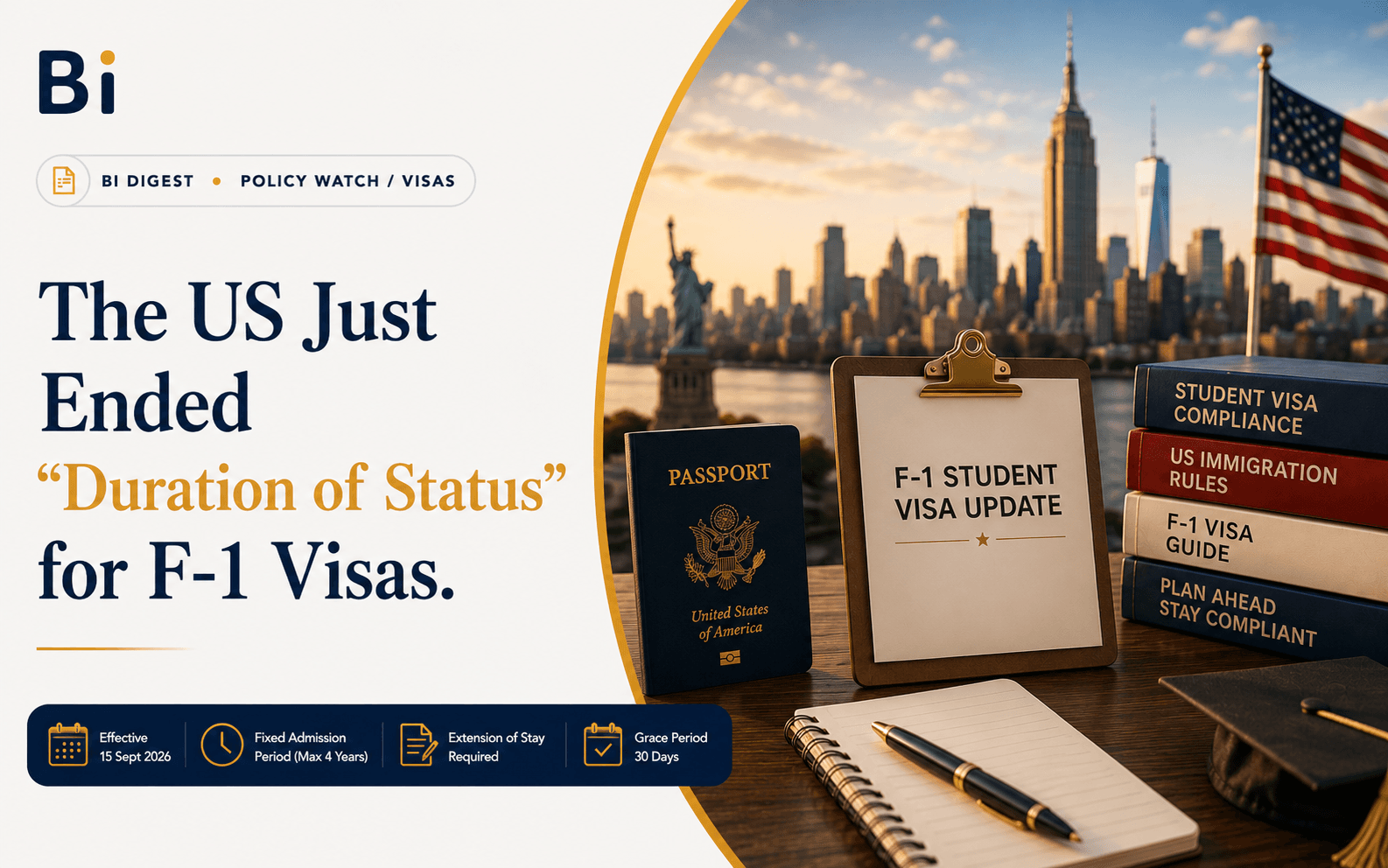
From 15 September 2026, F-1 students are no longer admitted to the US for "duration of status" — the open-ended stay that lasted as long as you remained enrolled. You'll now get a fixed admission period tied to your program, capped at 4 years, after which you must file a formal Extension of Stay with USCIS if you need more time.
By Mandeep Aulakh · Published 18 August 2026
What actually changed
On 16 July 2026, the Department of Homeland Security published a final rule eliminating "duration of status" for F, J, and I nonimmigrant categories, replacing it with a fixed period of admission. F and J students will now be admitted for a period tied to their program length, not exceeding four years — this covers university, college, and even private school-level F students. The rule takes effect 15 September 2026.
The practical shift: previously, if your program ran long — extra semesters, a delayed thesis, a change of research direction — you simply kept your I-20 updated and stayed compliant. Now, anyone whose program will run beyond their fixed admission period must file an affirmative Extension of Stay (EOS) application directly with USCIS, including a filing fee, biometrics, and evidence of sufficient funds — a formal government process that didn't exist under D/S.
| What | Detail |
|---|---|
| Effective date | 15 September 2026 |
| Fixed admission period | Tied to program length, capped at 4 years |
| Extension of stay | Formal EOS filing with USCIS required beyond the fixed period |
| Grace period after completion | 30 days (down from 60) |
The new rule, at a glance
Who this hits hardest
Not every F-1 student needs to worry equally. The population genuinely exposed here is anyone whose program structurally tends to run past four years. Doctoral students, research scholars, and long-format programs are explicitly flagged as the group most likely to need an EOS filing, since PhD timelines routinely exceed four years for reasons entirely outside the student's control — a funding gap, a change in faculty advisor, or a shift in research direction. DHS explicitly declined to create a longer admission period for this population despite this being flagged during the rule's comment period, so the four-year cap applies uniformly regardless of degree type.
A standard one-year UK-style masters equivalent, or a typical two-year US masters, is unlikely to bump into the four-year ceiling at all. This is primarily a PhD and long-research-program issue, not a concern for the majority of students on standard bachelor's or master's timelines — worth knowing before this news causes broader anxiety than the rule actually warrants.
Acceptable grounds for an EOS filing are specific: compelling academic reasons, a documented illness or medical condition, or exceptional circumstances beyond the student's control — not simply "still finishing the degree." If your extension is denied, there's no grace period at all — you must depart the US immediately, which is a materially higher-stakes outcome than the old system ever produced.
The grace period shrank too, and this affects everyone, not just long-programme students
Separate from the EOS mechanism, the standard departure grace period after completing your program (or post-completion OPT/STEM OPT) drops from 60 days to 30. This is the window students use to travel, wrap up affairs, transfer status, or simply leave the country in an orderly way after finishing. Halving it is a genuine planning constraint for every F-1 student graduating after the rule takes effect, regardless of how long their program was — it's not limited to the EOS-filing population above.
A 30-day grace period is also now granted before your program start date, to accommodate arrival planning — new, and generally helpful, but the post-completion side is the one that actually changes behaviour for graduating students.
OPT and STEM OPT: what's protected, what isn't
The single most reassuring detail in the whole rule: H-1B cap-gap protections are explicitly unaffected and continue operating exactly as before. That matters, since cap-gap is the mechanism that lets an F-1 student on OPT bridge into H-1B status without a status gap — this rule doesn't touch it.
For students already on OPT or STEM OPT when the rule lands, there's a specific transition carve-out: I-765 (work authorization) filings made on or before 18 March 2027 get relief from needing a separate EOS filing — worth confirming with your school's international office whether you fall inside that window rather than assuming either way.
One operational detail for anyone on OPT via severe economic hardship authorization, or on CPT: if an extension of stay application is filed while the underlying work authorization is still valid, employment can continue automatically for up to 240 days while the EOS is pending — but that 240-day window is a hard outer limit, not an indefinite bridge, and if the EOS filing happens during the new 30-day grace period specifically, practical training cannot begin or continue until the EOS is actually approved.
A restriction that will surprise people: you mostly can't change your mind anymore
Buried in the same rule, and arguably as consequential as the fixed period itself: F-1 graduate students are now generally barred from changing programs, majors, or education levels, or transferring schools, once a graduate program has begun, absent a qualifying SEVP-approved exception for extenuating circumstances. Undergraduates face a similar restriction for their first year, with narrow exceptions such as a school closure or a natural disaster disrupting classes.
This has a direct consequence for how program choice should be approached going forward: the decision now carries more weight before enrolment, because course-correcting after arrival — switching from a masters that isn't working out to a different one, or transferring to a better-fit university — is far more restricted than it used to be. If you're weighing programs right now, treat the choice as closer to final than it would have been eighteen months ago.
If you're already in the US on Duration of Status right now
You're not immediately affected on 15 September itself. Students currently admitted under D/S can remain, without filing an EOS, up to the Program End Date on their current I-20 (or the end of valid post-completion OPT/STEM OPT), with an outer limit around November 2026 in some transition scenarios — check your specific dates with your school's Designated School Official rather than assuming a blanket date. You'll generally keep the older, more generous 60-day grace period until you either travel internationally and get readmitted under the new rule, or you obtain an approved EOS — which means international travel during the transition period is worth thinking through carefully, since re-entry resets you onto a fixed I-94 date under the new system rather than preserving your D/S status.
What this means for planning a US degree from here
None of this changes whether the US remains a strong destination — it doesn't touch admissions, tuition, or the underlying quality of American universities. What it does is add a compliance layer that simply didn't exist before, and it rewards exactly the kind of careful planning we already push on every application: know your program's realistic timeline before you commit, keep your Designated School Official in the loop the moment anything about your timeline shifts, and build in calendar buffer around your grace period rather than assuming you'll sort logistics out after finishing. For the large majority of students on standard-length bachelor's and master's programs, this is a background administrative change, not a reason to reconsider the US. For anyone eyeing a PhD or an especially long research program, it's now a genuine planning variable to build into the decision from day one, not an afterthought.
Frequently Asked Questions
When does the F-1 duration of status rule take effect?
15 September 2026. It applies to F, J, and I nonimmigrant categories, and affects students already in the US as well as new arrivals, though existing students get transition protections tied to their current I-20 dates.
Does this affect every F-1 student, or just some?
Mostly it's a background change for standard bachelor's and master's students, whose programs rarely exceed the 4-year cap. It's most consequential for PhD students, research scholars, and anyone on a program that runs long for reasons outside their control.
What is an Extension of Stay (EOS) and when do I need one?
A formal application filed with USCIS, with a fee, biometrics, and proof of funds, required if your program will run beyond your fixed admission period. Acceptable reasons include compelling academic need, documented illness, or exceptional circumstances — not simply "still finishing."
Does this rule affect OPT, STEM OPT, or H-1B cap-gap?
H-1B cap-gap protections are unchanged. Students already on OPT/STEM OPT when the rule takes effect get a transition carve-out if their I-765 was filed by 18 March 2027. The post-completion grace period does shrink from 60 to 30 days for everyone finishing after the rule takes effect.
Sources
Final rule published 16 July 2026; ends D/S for F, J, I categories; effective 15 Sept 2026
DHS, official announcement ↗Final rule published 16 July 2026; ends D/S for F, J, I categories; effective 15 Sept 2026
Study in the States (DHS) ↗Fixed admission period capped at 4 years; EOS filing requirement; doctoral/research students most exposed
Nixon Peabody LLP ↗DHS declined a longer admission-period cap for doctoral/research students
Klasko Law ↗Grace periods (30 days before start, 30 after completion); EOS grounds; no grace period if EOS denied; 240-day auto-extension mechanics
Ogletree Deakins ↗Restrictions on changing programs/majors/schools at graduate level and undergrad first-year
Fragomen ↗H-1B cap-gap unaffected; I-765 transition relief through 18 March 2027; 240-day window is a hard outer limit
Duane Morris LLP ↗Transition rules for current D/S students (existing I-20 end date protections; 60-day grace period retained until travel or EOS approval)
Yale OISS, Elimination of Duration of Status FAQ ↗Figures and rules change; always confirm against the official source for your application date.
Have a question this didn't answer?
Every situation is different. Talk to a counsellor for advice specific to your profile, budget, and timeline.